What shirt are you buying for next season, legacy fans?

Introduction

A few years ago now, back in 2014, I hosted a conference on sportswear, and one output from that was an edited collection by a range of writers from different disciplines. With Christopher Stride, Nick Catley and David Moor, I co–authored an article on shirt design in the early replica football era, you can read it here 

Using our combined research, and looking at the archives of various manufacturers, we looked at the current historical popularity of wearing a shirt to support a given team, and how this had changed over time. Most people take this for granted today, but my Dad, who was a season ticket holder at Leicester City from the 1960s onwards, would never have worn a shirt to support his team. Nor would my Mum, when we went with her to most home games, and some dramatic trips to Wembley in the 1990s. So what is the historical moment we are in, and when did legacy fans, and heritage fans become important to a club’s marketing team?
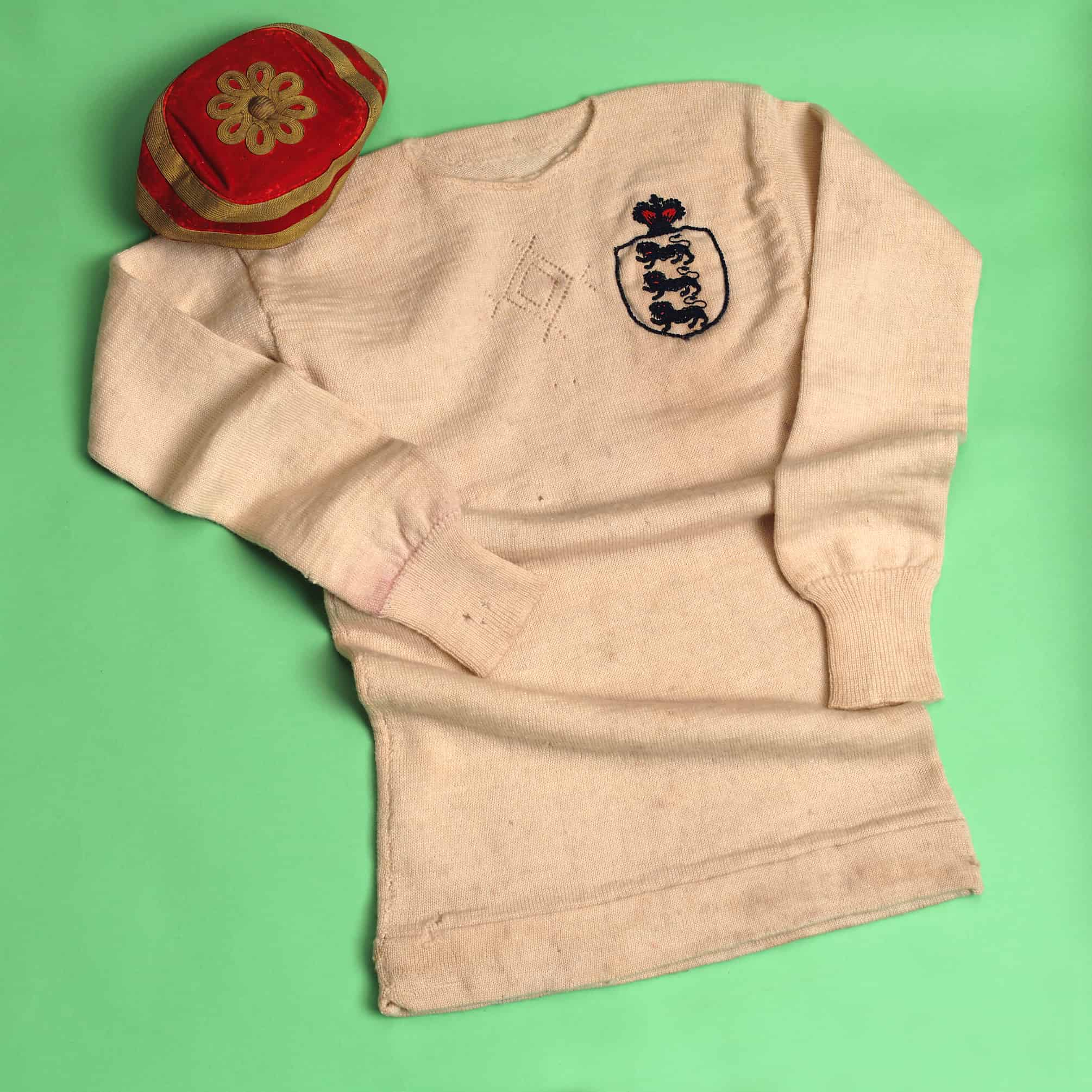
White Kirke Smith England shirt 1872
This shirt belonged to one of England’s eight forwards in the 1872 fixture against Scotland, Arnold Kirke Smith. He was the captain of Oxford University’s football team and later a Cambridgeshire vicar. The teams played a 0-0 draw. It is a very rare early shirt reflecting the use of simple fabrics.
From Dressing Like Your Parents, to Dressing Like Your Kids

The football shirt is iconic, contributing to a club's visual identity in part, through its role as sporting uniform and, when commercial sponsorship was allowed, as a vehicle for fan consumer interactions. But as a fan identifier, the shirt has its own history, and quite a recent history, both as a focus of nostalgia and of collector culture. So, how did the replica shirt replace the home made fan culture of knitted scarves, rosettes, and whole outfits in club colours, and become worn as cross-generational leisurewear?

Until the 1950s, although there were adult and youth styles of clothing, many young people moving into middle age dressed in much the same way that their parents did. But a wider historical move which valued meritocracy, saw people choose how to dress as they moved through life in whatever way they saw fit. Meritocracy valued the talents of individuals, rather than consigning them to a particular class, or gender. We can see the idea in education where more young people were encouraged to study for a further and higher education, as in the film Educating Rita

So rather than dressing like their parents, more teenagers began to dress in their own fashions with designers like Mary Quant democratising fashion. This process continued and accelerated until, by 2000 when Eminem released The Marshall Mathers LP, parents, who were by then taking their children to his concerts began to dress more like their offspring. Some trend analysts dubbed this look kidulthood, or ‘middle youth.’ Bill Osgerby argued youth cultures and markets have ‘expanded way beyond their generational base to embrace consumer groups in their … thirties and older’. So kidulthood was around way before the term was used for a media series.
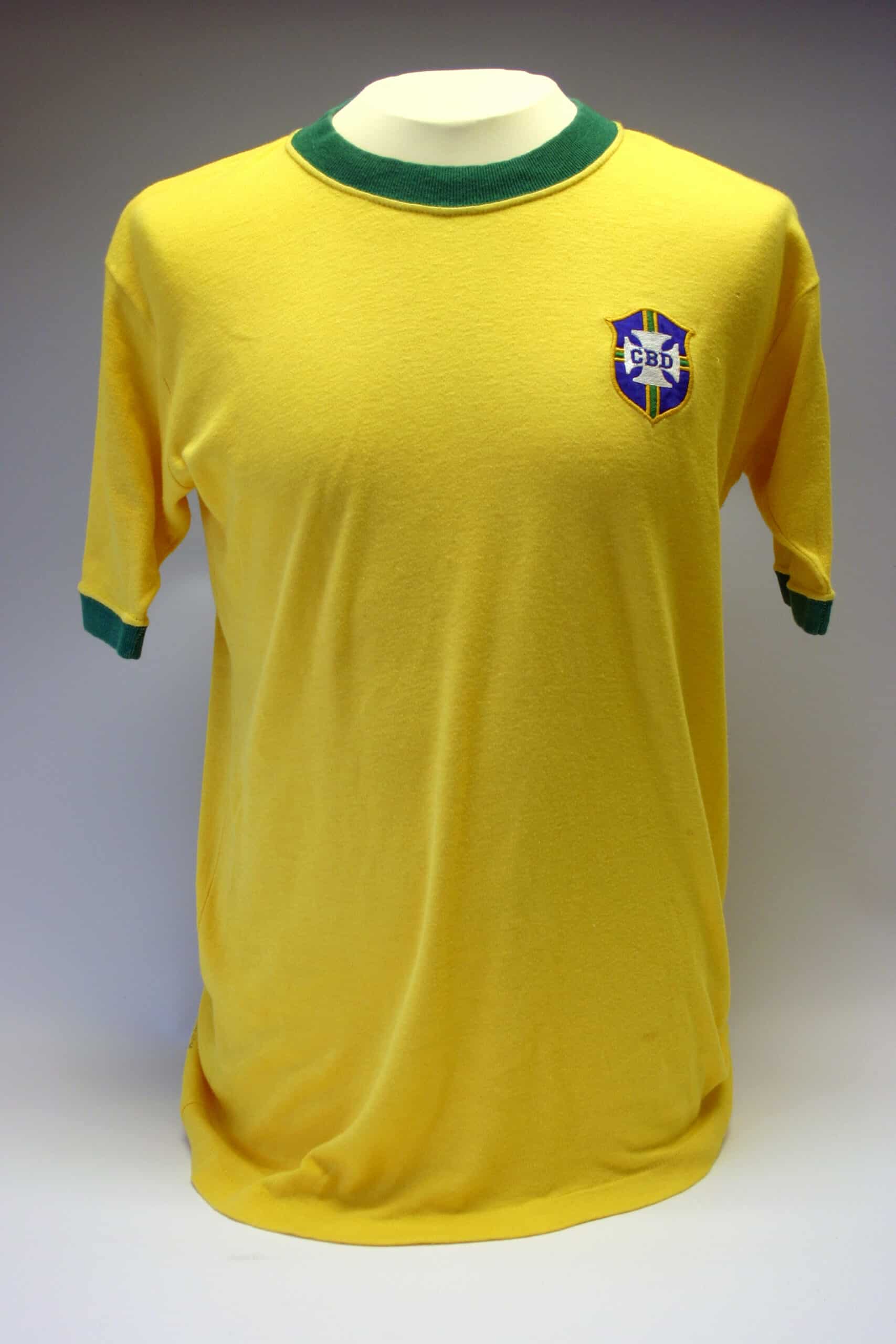
Rivelino Shirt
This plain, iconic gold and green shirt again reflected that by 1970 jersey fabrics were basic, and more like T shirts worn on the street than the modern football shirt. If you wore it, could it make you play more like the World Champions, like Pele or Rivelino?
At the Mexico World Cup in 1970, Brazil won the Jules Rimet Trophy for the third time and so it was awarded permanently to the Brazilians. Roberto Rivelino (born 1 January 1946, in São Paulo) was the son of Italian immigrants who became known by his trademark moustache and graceful, attacking midfield ingenuity. Rivellino’s main nickname was Patada Atomica, roughly translated as ‘atomic shot’, but he was also known as the ‘king of the park,' before retiring from professional football in 1981. Rivelino started most games for Brazil in the 1970 World Cup, scoring three goals and was credited by Pele as one of the finest 125 players in the world. In 92 appearances for Brazil between 1965 and 1978 he scored 26 goals.
British Football Fans in Europe, Casuals

From the late 1970s, the casual supporter subculture was marked by both hooliganism and expensive designer clothing at matches, as more young fans could travel to European games on increasingly cheap flights. On their travels, fans bought, or stole, continental designer items by Lacoste, Sergio Tacchini, and Fila. Adidas was already established as leisurewear in the 1950s, and Ellesse, although initially popular as a 1970s skiwear brand, gave legitimacy to quilted jackets in garish colours appearing on the terraces.

The casuals in question linked designer names with supporter culture. Some had links with key British designers such as Hackett & Fred Perry, the latter often through Mod culture, and skinhead styling. Stone Island, and CP Company came later in the 1990s. But casual fans did not wear club colours, so it was easier to move about in public, and by then mobile phones made connectivity easier.

The willingness to display brands as part of fandom was an opportunity that big clubs, and national teams, could not ignore, and, at the same time, there was a market for replica shirts that had been under exploited amongst adults. Interestingly, if you look at the website of most of these major brands now, they now have heritage collections.
Maradona Shirt
By 1986, we can start to see the influence of sports brands, in this case Le Coq Sportif, as part of the branding of shirts. This is a notorious match-worn shirt.
What made it famous? In England Maradona’s shirt from the Mexico World Cup will always been associated with the “Hand of God” goal, linked paradoxically with the divine. With some distance, most have forgiven the first because of Maradona's brilliant second goal against England, scoring an even better one against Belgium and also made the decisive pass of the final.
When the whistle blew, for the last time in World Cup history, the crowd invaded the pitch. Maradona was the hero and captain.

Children’s Replica Shirts

No such formalized market for football kits, and leisurewear existed prior to the 1950s. One big change was the training shoe market, which had started as an item of fitness equipment, and moved onto the streets, allowing young men, and women, to wear comfortable, brightly coloured branded footwear. After years of black and brown ‘sensible shoes’ this was important for men particularly, and more practical than winkle pickers.

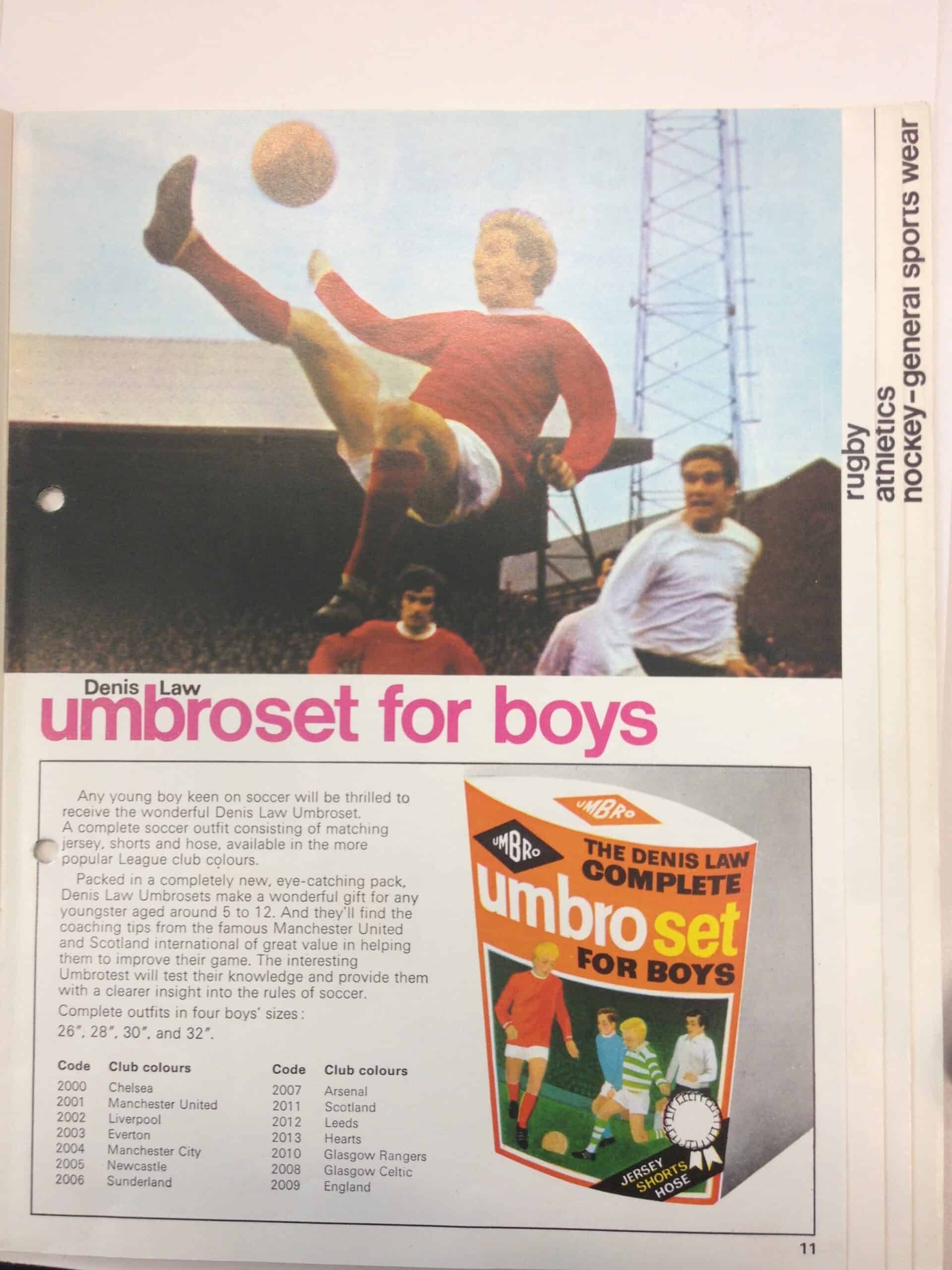
Also in the 1950s, Umbro began to market packaged child-sized kits specifically to individual customers (as opposed to youth teams) as presents, almost more part of the gift or toy industry than the clothing business. The kits were sold in an illustrated presentation box, later branded as an Umbroset. You can see an image of the Umbroset as part of this free to download article here with thanks to Umbro and Dr Chris Stride.

Clubs were late to this market. Some stocked replicas in their club shops and promote sales through their match programme. But this was as a link of child-replica kits to a prominent manager, like Matt Busby, or footballer. Maybe your child could become the next Denis Law by wearing the kit? Footballers had already endorsed boots for decades.

So this was not about the authenticity of the replica in being an exact copy, it was a playful toy to inspire, in the club colours of. This spread from Umbro to Adidas, who already produced child’s versions of its footwear and clothing, to Admiral of Leicester by 1972.

Admiral then innovated again by copyrighting their design for Leeds United, in 1973, then at the height of their powers, and determinedly ‘modern’ in outlook, becoming sole legal supplier to retail. Quickly realising that branding was defining sportswear, and also realising that most Football League Clubs had a history of over 100 years, and hence an authority to the brand, the replica shirt business was transformed in five years. Cool ‘continental’ brands like France’s Le Coq Sportif of France, and German Adidas rivals Puma, joined the fray.

Just as the tracksuit gave way to the brightly coloured shell suit of the 1980s, and incomes rose and public display of wealth became more socially acceptable. The first designer jeans, produced by Gloria Vanderbilt and Calvin Klein, from the 1970s onwards were the perfect foil to the new football shirt culture on the terrace, and remain a standard look now.
Uwe Seeler tracksuit by Adidas
Uwe Seeler, one of Germany's most prolific goalscorers was used by Adidas to promote tracksuits for children and youths, initially as gifts or treats. Like the Denis Law Umbroset, the youth market was targeted for replica items before the adult market.

Conclusion From Authenticity to Nostalgia

If you compare the Rivelino shirt of 1970, with the Maradona shirt of 1986, the changes of branding were apparent at World Cups, as well as club football.

As the Premiership changed the media landscape of football, so new fans flooded in to the game, pushing up prices and in a seated crowd with less violence in stadia, the look of fandom became ever more affluent. Just as the trainer market was revolutionised by Air Jordan in 1984, with fans now willing to pay over £100 per pair, so the replica shirt industry became an aspirational product. Clubs responded by changing their designs ever more frequently after the inauguration of the Premiership because they were not just selling to those who could make their way into the stadiums, but to those watching on satellite television. It became a global marketplace. So those fans who remembered seemingly simpler times became the ‘legacy fans’, for whom nostalgia, was part of their experience as authentic supporters before this time. Another post will explore how this has been used in other areas of the fan experience in stadia, or ‘tradiums’ as academics now call the megastores.
Denis Law Umbroset for Boys
Perhaps Denis Law was a safer bet, marketing wise, than George Best!