Introduction
With the publication of Sir Lewis Hamilton’s Accelerating Change: into improving representation of Black people in UK motorsport
Hamilton Commission Report, there has been a new spotlight on Equality, Diversity, and Inclusion into what is considered by many people to be an elitist sport and leisure pursuit. In particular there was a perception expressed in Accelerating Change amongst the young women surveyed that there was low awareness of motor sport, that there were no opportunities for access, and that it was a male domain. This was the case for both white young women, and those from Black and Asian backgrounds. An animated version of the report is available
here. Obviously, the findings of Accelerating Change look at the intersection of gender, social class and ethnicity on the life chances of individuals and the findings have many useful elements, for education and the motor sport industry.
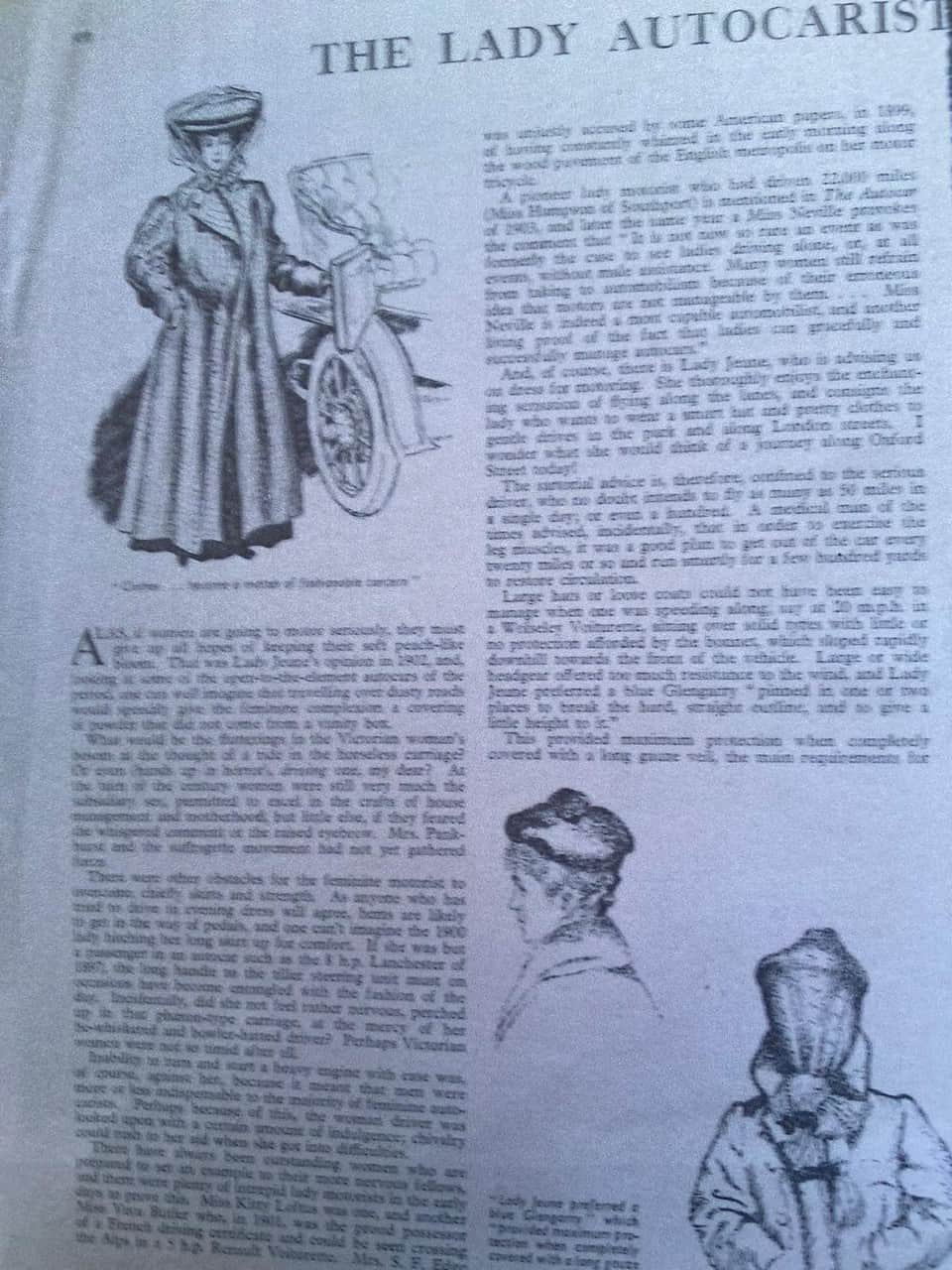
However, in this blog post it is worth saying that, although the numbers of women from all backgrounds in motor sport is noticeably low in 2021, if we go back to the beginnings of the industry, women were very much represented. So who were they, and what were their roles?
Women in Early Motoring and Motor Sport
Most people, for example, will be aware of Bertha Benz who drove 180 kilometres between the cities of Mannheim to Pforzheim in August 1888. The name Mercédès famously came from the daughter of Emil Jellinek, the commercial partner of Karl Benz; Gottlieb Daimler and the 'King of constructors' Wilhelm Maybach. A duo of French aristocratic women made motoring fashionable. Hélène de Rothschild, Baroness van Zuylen competed in the 1898 Paris to Amsterdam race under the pseudonym Snail (her husband, Etienne, competed as Escargot). Her compatriot, Anne de Mortemart, Duchess d’Uzès, was also famous for her hunting skills and has been credited with being the first European woman to pass a driving test on 23 April 1898. She also appears to be the first to be caught speeding in her 2-cylinder Delahaye at over 12 km per hour on 9 June in the Bois de Bologne the same year.
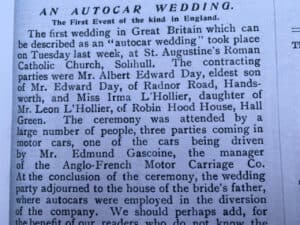
In April 1897, Irma L'Hollier married Albert Day at St Augustin's Roman Catholic Church, Solihull. Irma's father was an importer of foreign-made vehicles and the groom was an assistant manager at the Anglo-French Motor Carriage Company, specialists in Roger-Benz cars. The Birmingham marriage was celebrated in The AutoCar for using at least three vehicles for 'the diversion of the company' at the reception: the author wished the pioneering couple: 'As much happiness in their married life as there was novelty in their wedding, which will stand as the first British motor car marriage on record.'
The many and varied fashion statements of Camille du Gast perhaps deserve a jjheritage.com blog in their
own right. Du Gast was famous for sometimes wearing full dress uniform and an admiral's hat but was also a daring racer, the ‘Amazon with green eyes’ who finished thirty-third out of 122 participants in the 1901 Paris to Berlin race. In 1903 the ACF and the ACE organised a Paris to Madrid event, known after as the 'race of death' because fewer than half of the three hundred cars finished and there were at least eight casualties, with rumours of many more injured. Du Gast dropped from eighth place to finish to forty-fifth, after stopping to help an overturned De Dietrich and administering first aid to its injured driver. Her patient survived to race again. By 1904 she was invited to become a member of the ACF.
After a ban on women in the 1904 Berlin to Paris Gordon Bennett Cup, supposedly due to their more nervous disposition, Du Gast, also known as ‘the Valkyrie of the motor car’, then piloted a Darracq motor-boat (wearing a violet costume and a captain’s hat) in an open-sea race from Angiers to Toulon where all of the vessels found misfortune. Rescued by the destroyer Kléber, she was declared the winner two months later.
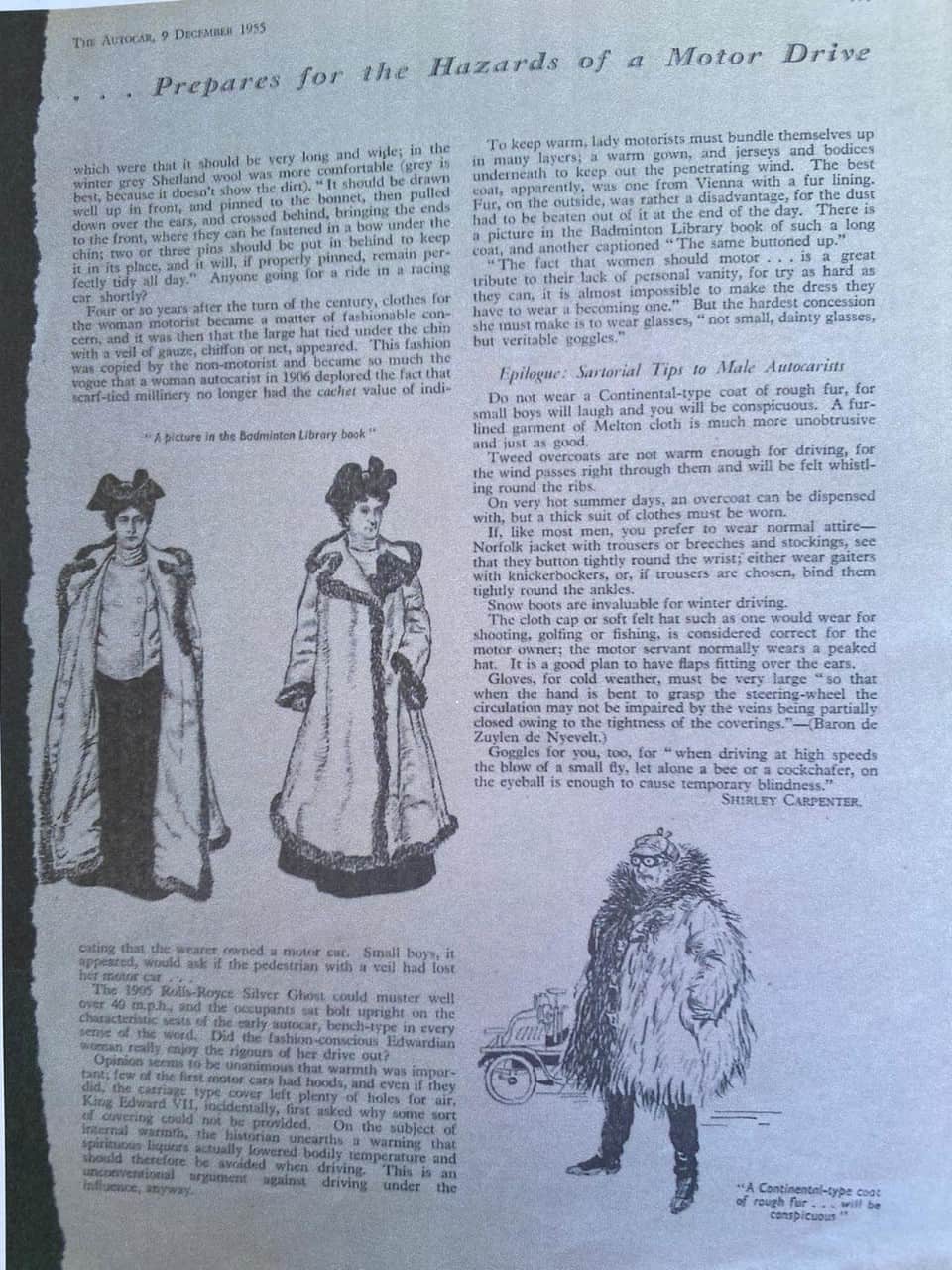
By 1902 Alfred Harmsworth had endorsed his enthusiasm by editing Motors and Motor Driving for the Badminton Library. It contained an engraving with the caption ‘Her Majesty the Queen in Her Electric Car at Sandringham.’ A 'motor stable' was established by Queen Victoria at Buckingham Palace for more vehicles and the car became used as part of routine business, though the ceremonial aspects of royal life were left to horsepower.
Brooklands and its owner/constructor Ethel Locke-King
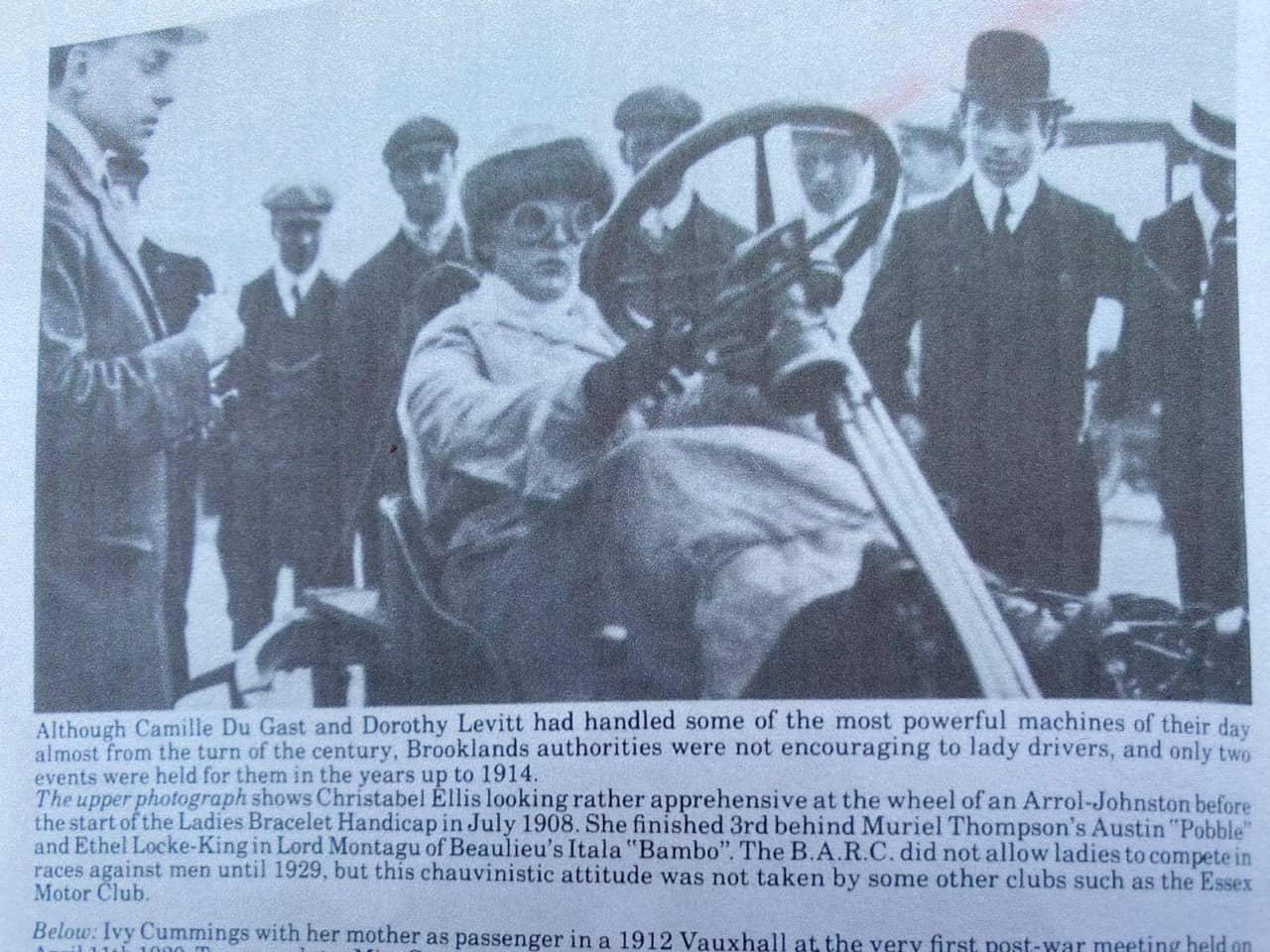
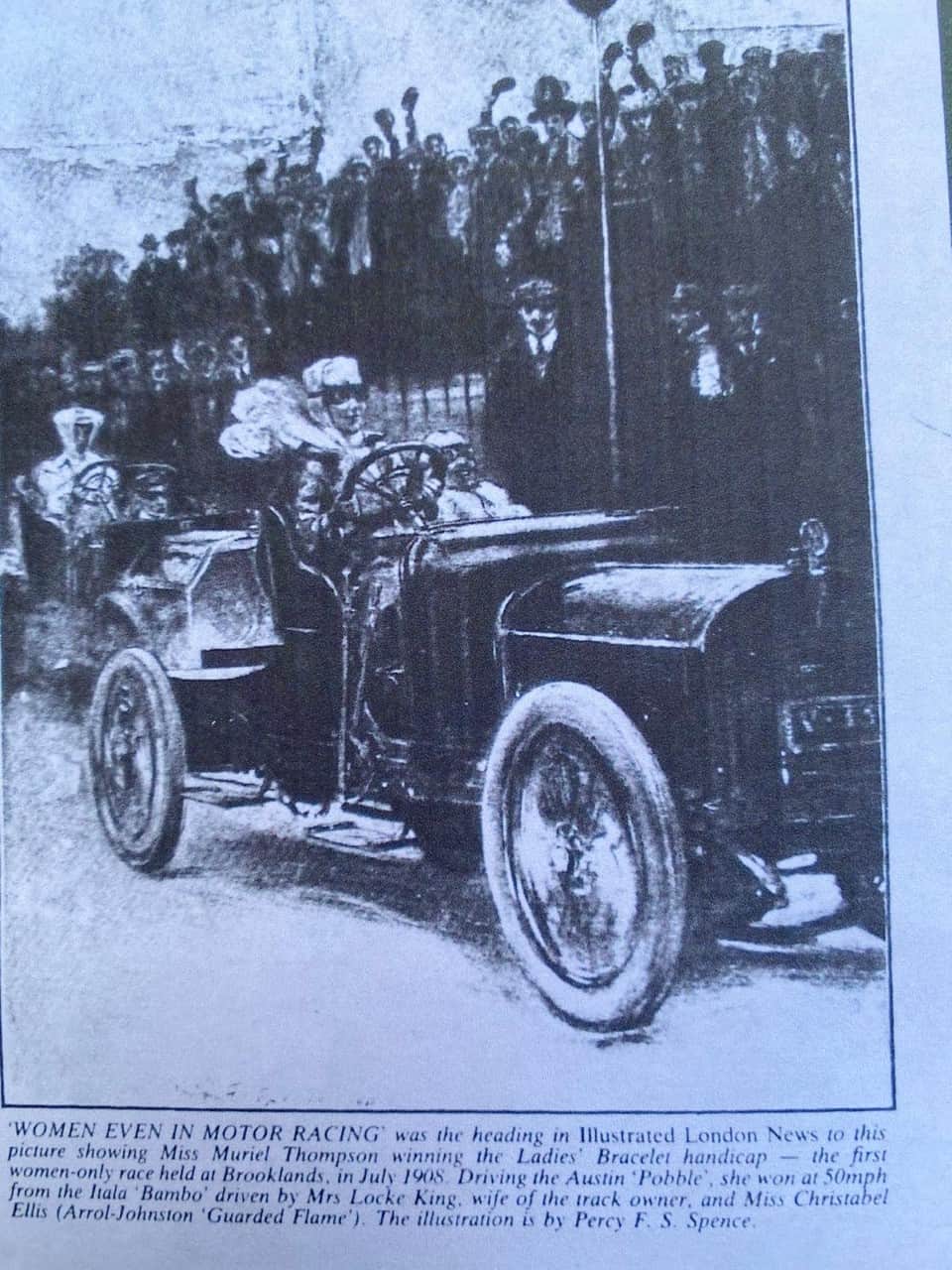
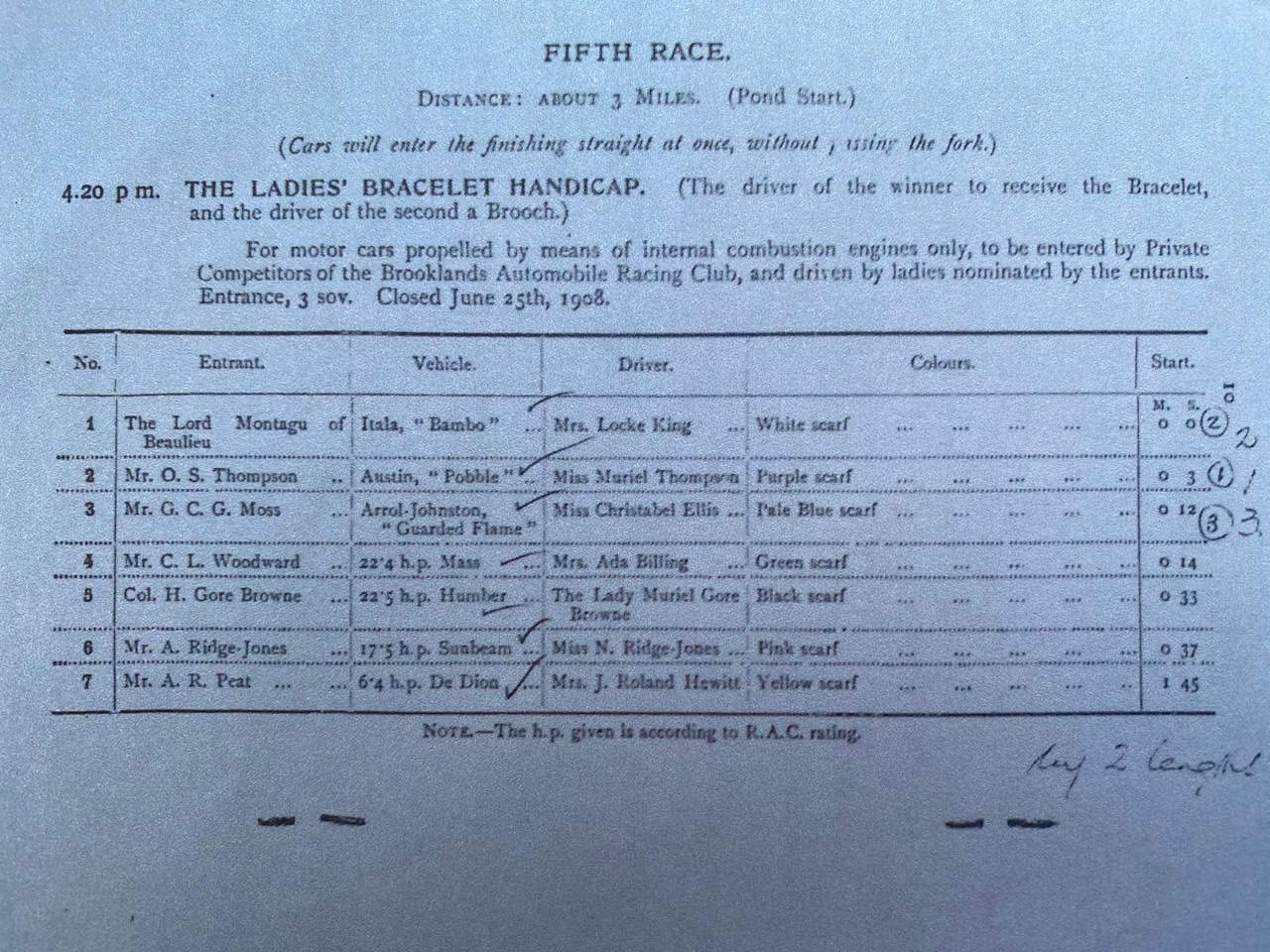
Brooklands in Weybridge, Surrey opened in 1907 and is often called the 'birthplace of British motor sport.' Husband and wife, Hugh and Ethel Locke King provided the land for the circuit close to Brooklands House, which had been built in 1862 by Hugh's father. As the only surviving son, Hugh had inherited 4, 600 acres of land on his father's death in 1885 mainly in Surrey, Sussex and Devon. Having married in 1884, Hugh and Ethel dabbled in development according to their enthusiasms, most notably the Mena House Hotel in Cairo, residential estates at Portmere Park Weybridge and the New Zealand golf club near Byfleet. The Locke Kings had a large 70 horsepower Itala car which Ethel often drove. Hugh was less intrepid, saying ‘You can’t have very big accident in very small car.’ The construction of a motor racing track at Brooklands was their largest and most ambitious project, costing an estimated £100,000, plus additional family funds when it became clear that the initial outlay would not be sufficient. The original estimate had been £22,000.
In many ways, Brooklands was a monument to nationalism in the British motor and air industries, of which racing was as much consequence as a purpose. When work began Weybridge was a village with a population of under 6, 000. The narrative that accompanied pictures of the construction in the Illustrated Sporting and Dramatic News, Daily Chronicle, Daily Graphic, Country Gentleman and The Daily Mail frequently referenced great Victorian engineers and their feats. The River Wey was diverted, bridges and railway viaducts commissioned but, crucially, the surface was built of gravel and Portland concrete, not the new, and prohibitively expensive, 'Taafalt' asphalt. Bumps in the race-track would cost many of Brookland's drivers broken noses and lost teeth when encountered at speed because helmets were often soft and open-faced in design.
Practicalities aside, the venue quickly became known as 'Motoring Ascot' or, more clumsily, the 'Epsom of Automobilism' because of its part in the cosmopolitan lifestyles of the Locke Kings and their friends. The proletarian holiday venue Skegness, in Lincolnshire, would later try to gentrify its image by claiming to be 'Brooklands by the Sea' after hosting races on the sands in the 1920s, featuring well known drivers from the track, including Ivy Cummings.
Ethel Locke King was therefore partly responsible for the funding of one of Britain's most iconic sporting sites and helped to set the tone in which competitions took place at an internationally important sports facility. Her influence should not be overstated: there were two official women's races before World War One, in spite of constant lobbying by female drivers. However, more evidence of women taking part in mixed events is gradually emerging. Racing aside, it was clear that without her intervention the track would not have been finished and, subsequently, women were very much part of the social scene.
Conclusion
Racing drivers like Dorothy Levitt, who was of Jewish heritage, quickly became famous. Many disappeared from public life just as suddenly. So while this blog post has looked at how British ambivalence to racing motor-cars on roads led directly to the establishment of Brooklands as the world's first purpose-built circuit, later posts will look at the career of Dorothy Levitt and others. The Locke-King privately-owned track tapped into elite patronage of the British 'season', initially using the lexicon and routines of horse racing. Though most of the women who competed there did so in the inter-war years, there are several notable early examples of women taking part in motor sport rivalries before World War One to be the first, the fastest and the most able to endure.