Introduction
Sport has had such a profound effect upon the clothing, footwear and accessory industries that it will influence the sartorial choices of every reader of this blog, ‘sporty’ or not. This certainty is not some provocative assumption that those who read it are wearing their favourite replica shirt, either. The wardrobe of everyone has been fundamentally shaped by sport too, even if they are part of the majority who do not particularly like, or actively participate in, active leisure. The costume choices of women, men, boys and girls today are bound up with the technological and stylistic innovations of specialist sports clothing but also the broader diffusion of leisure apparel in globalized markets. Today, sports kit is a ubiquitous and significant marker of identity. But when did this begin? What were the origins of sportswear?
From Folk to Modern Sport
Many people consider that modern sport, as opposed to older folk forms, was really born with the codification of the Victorian period, when association football (1863), the rugby football union in 1871, and the Amateur Athletic Association (1880) were formed. But there was more than one industrial revolution in the UK, and from 1760 onwards steam and water mechanised production methods. This chimed with a move from rural agrarian economy to more larger urban centres, and sport was a product of that. The Marylebone Cricket Club formed in 1787, becoming a governing body as well as a club, and Broughton’s boxing rules, named after fighter Jack Broughton, offered some protection in bare-knuckle bouts. So the eighteenth century, rather then the nineteenth saw these changes from folk to modern sport accelerate.
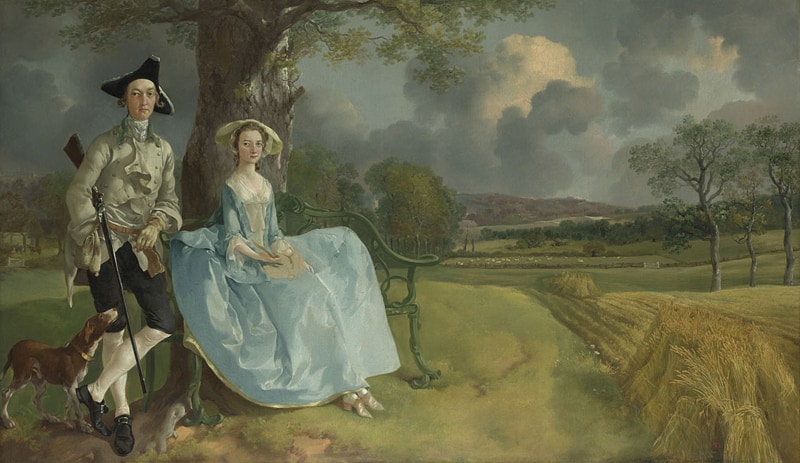
Mr and Mrs Andrews by Thomas Gainsborough circa 1750
So what do we see in
this painting? It is oil on canvas and 69.8 x 119.4 cm in size. Quite small.
Look for yourself and what do you see? Does anything about the painting strike you as odd, or notable?
This is definitely a portrait. Mr Robert (1725–1806) and Mrs Frances Andrews (circa 1732–1780) has been described as a ‘triple portrait’ – of Robert, Frances and their land. Previously, many portraits of the great and the good had been completed indoors to show off wealth and expensive clothing. There had even previously been something called sumptuary laws imposed by rulers to curb the expenditure of the people. Such laws might apply to food, beverages, furniture, jewellery and clothing. As such, portraits which feature fine food, clothing or belongings were markers of regal entitlement.
But Mr and Mrs Andrews are just that, husband and wife. There is no royal title or other aristocratic link. We are not looking at Lord and Lady Andrews. But we are looking at landed gentry, below the peerage on the social scale, and so no title, but able to live off their considerable landed assets through rent and loans with high rates of interest. Why was this important?
Behind Mr and Mrs Andrews is a wide view looking south over the valley of the River Stour. Robert Andrews owned nearly 3000 acres and much of the land we see here belonged to his family, and when he married Frances, he married someone whose family also had land and a country house. We think Robert was about 22 and Frances 16 when they married. Frances’ family had an estate that bordered Robert’s family and part of this was her dowry. So the landscape showed the uniting of two great landed families. Gainsborough innovated depicting convincingly changing weather and naturalistic scenery. It is somewhat agricultural rather than in formal gardens, but it is the scale of the land that is significant.
This is mid-eighteenth century bling! The unpainted patch on Mrs Andrews’s lap may have been intended for a lapdog or a baby to be added at a later date. The whole scene is about prosperity and virility. The Essex countryside is lush and verdant, the young couple, and their dog pose beside their fertile harvest field and well-stocked pastures. Mr and Mrs Andrews are at home in the landscape they own.
But What Are They Wearing, and why do you call it sportswear?
The Andrews’ are equal in their informality, but in different styles. They did not need to dress up in formal attire because 1. they are young and 2. they own the place! When there was no need to work, the Andrews’ could choose to dress as they liked, and the emphasis on leisurewear, specifically linked with Robert’s sporting interests, was a pioneering first. It is sportswear, not to shoot or to take part in active leisure, but to symbolise the idea of leisure itself.
Robert is as informal as the landed gentry was likely to be seen in public, even on his own estate. His clothes virtually fall off his frame, so floppy is the styling, and Robert himself seems to require the support of the bench to remain upright.
Bear in mind, that in the eighteenth century, and well into the nineteenth, sport was often synonymous with blood sport in Britain. Robert wears what seems a slightly incongruous, white linen loose hunting coat, almost shiny in appearance. The green collar adds detail, along with dangling bags for gunpowder and shot. His hose and shoes indicate he is doing no taxing sport, but is sporting a gun and accessorised by a gun dog who will fetch what he shoots.
The dog looks at Robert adoringly. Not so his wife. Frances wears an informal summer suit with a separate skirt and jacket of light blue, informal shoes and a straw hat. The poses are nonchalant and both stare back at the viewer, as if to say ‘what are you looking at?’
Sportswear is often worn to denote youth, or youthfulness in attitude. It is also often aspirational. The painting is set on a warm summer day, just before harvest, at the start of what would be a fertile marriage, with the couple having nine children before Frances died aged 48. Robert remarried and lived until he was 80. For now though, their lives are ahead of them, and they are in their favourite togs, as opposed to their best clothes. As Robert’s rakish tricorn hat points upwards, it suggests that their legacy will be considerable, and, as we approach almost two hundred years of sportswear, they have transcended the landscape in which they were depicted. For some other perceptions of this painting at the National Gallery read, and listen
here.